The Art Process
The Artistic Process
The tension between control and chaos is what drives it for me. This medium dries so fast that every stroke and shape happens almost instantly. It forces me to be direct—to really think about placement, form, and contrast before I place the mark. When I’m painting, it feels like a rush with every move: exciting, terrifying, tense… and somehow relieving all the way through.
I can't tell you how many pieces I've thrown away.
Ink & Materials
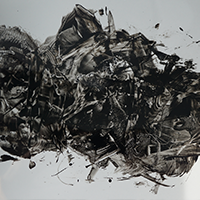
I’ve been developing this process for about six years now, and I’m still fine-tuning the steps to match the vision I’m chasing. It began with ink on film—literally soaking transparent film in alcohol and mixing alcohol directly into the inks. That combination continues to give me the most dynamic results.
My tools are custom shapes and textures I create before and during each session. Just like traditional painting, the ink is applied and then manipulated with deliberate strokes. Each material leaves its own signature, creating shapes I couldn’t replicate any other way.
Because the medium dries fast—usually within 30 to 45 seconds—every motion has to be intentional. Once a stroke is made, there’s no walking it back.
Adhering the Film to Its Background
After the ink has settled, I mount the transparent film onto either a glossy or matte background using a specialized industrial adhesive. This stage is the most intense part of the process—the background bonds almost instantly, leaving no room for correction.
If the film shifts or needs to be lifted, it can tear, bend, or pull glue away in a way that permanently alters the piece. Every mount requires precision, patience, and a steady hand.
Photography
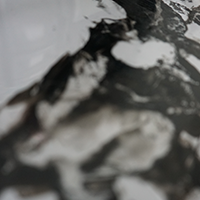
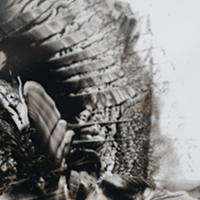
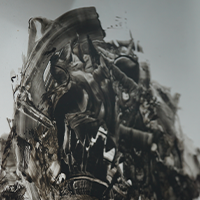
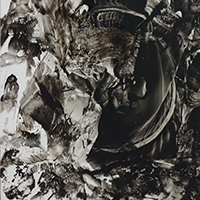
Once the artwork is fully bonded, I photograph it using a macro lens to capture the details embedded within the ink and film. I’ve realized that showing the final piece online is never enough—macro photography reveals the depth, texture, and micro-worlds inside each stroke.
These close-ups give viewers who can’t stand in front of the physical work a chance to experience it as they would at a gallery—exploring angles, shapes, and moments they might otherwise miss. The black-and-white images become their own artwork, offering a parallel interpretation of the original.
Framing
I’m still experimenting with framing, but my long-term vision is to mill wood directly from our land and create custom frames for each piece. I want to carve them from scratch, stain them by hand, and make the frame feel like an extension of the art itself.
I won’t frame the macro photos this way—those are byproducts, reflections of the originals. The handcrafted frames will be reserved for the core painted works.